
Mental Health & Family Resources
Supporting Every Spartan
The goal of this page is to connect students, parents, and our community with mental health services and supports. Caring for our mental health is an essential part of every student’s well-being and success. Just like physical health, it is something we all need to take care of. Knowing where to turn for support can make all the difference in a time of need.
The North Schuylkill Mental Health team, made up of school psychologists and school social workers, works alongside counselors, teachers, administrators, and families to make sure students have the resources and support they need to be healthy, safe, and ready to learn. Families are encouraged to reach out to any member of the team with questions or concerns. Please check back, as resources are added throughout the school year.
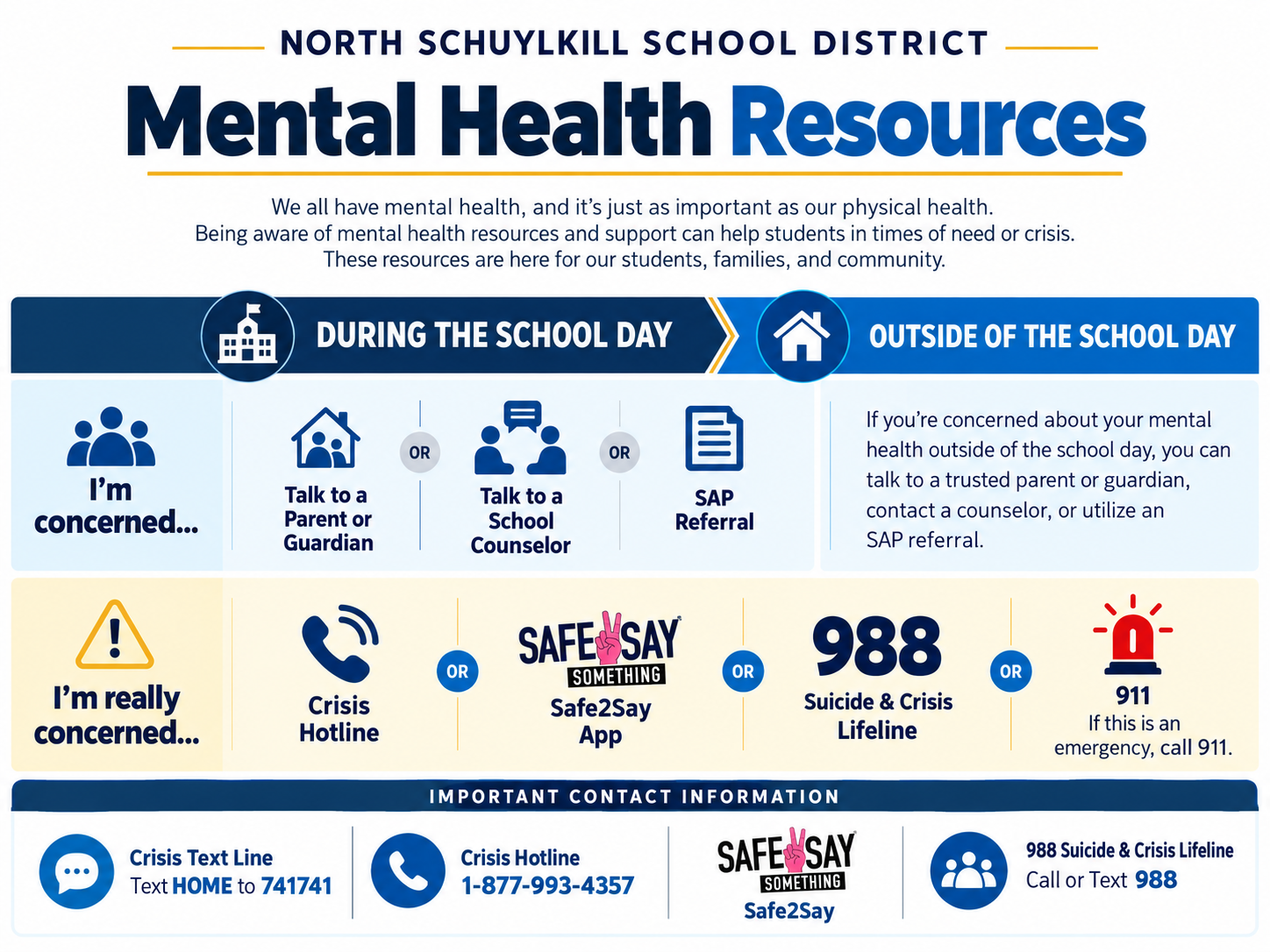
If You Need Help Now
If someone is in immediate danger, call 911.
988 Suicide & Crisis Lifeline: Call or text 988, or chat at 988lifeline.org (opens in new window). Free, confidential, 24/7.
Schuylkill County Crisis Hotline: Call 1-877-993-4357 for 24/7 local crisis intervention, mobile crisis, and emergency services, operated by the Center for Community Resources. A walk-in crisis center is open at 91 S. Progress Avenue, Pottsville, Monday to Friday, 10 AM to 8 PM.
Crisis Text Line: Text HOME to 741741 to reach a trained crisis counselor.
Safe2Say Something: Report a concern about a student who may be a danger to themselves or others at safe2saypa.org (opens in new window), through the Safe2Say app, or by calling 1-844-723-2729.
Which number should I use?
Use 911 when someone has been hurt, has taken something harmful, or is in immediate danger. Use the Schuylkill County Crisis Hotline when a child or family member is in emotional crisis and you need local help, including a mobile crisis team that can come to you. Use 988 for yourself or someone you are worried about when you need to talk to a trained counselor right away about suicidal thoughts, a mental health or substance use crisis, or any kind of emotional distress. Use Safe2Say to report a concern about another student, anonymously if you prefer. If you are not sure which to call, any of them will help you and connect you to the right place.
Safe2Say Something is run by the Pennsylvania Office of Attorney General. It teaches students and adults to recognize warning signs, especially on social media, and to say something before it is too late. Tips are reviewed 24/7 and shared with school officials and, when needed, local law enforcement.
↑ Back to topServices We Provide
- Individual and small-group support for social, emotional, and behavioral concerns
- Psychological evaluations and participation in the multidisciplinary evaluation process
- Crisis response and support for students and families
- Connections and referrals to community mental health resources and outside agencies
- Consultation with families, teachers, and administrators
- Support with attendance, basic needs, and other barriers to learning
- Coordination with school counselors, the Student Assistance Program, and school-based behavioral health partners
Who Should I Contact?
Several people at school support student mental health, and it is not always clear who to call first. Any of them will listen and point you in the right direction, but this guide can help.
School Counselor
- Your child seems worried, sad, or not themselves
- Friendship problems, bullying, or peer conflict
- A change at home such as a move, separation, or new sibling
- Classroom guidance lessons and short-term, school-based counseling
- Starting a Student Assistance Program referral
School Social Worker
- Help with basic needs such as food, clothing, or school supplies
- Housing instability or homelessness (McKinney-Vento)
- Connecting with community agencies, insurance, or outside counseling
- Attendance concerns and barriers to getting to school
- Family stress, grief, or a crisis affecting the whole household
School Psychologist
- Questions about how your child learns, pays attention, or processes information
- Psychological evaluations and the special education evaluation process
- Behavior plans and school-wide behavioral supports
- Crisis response and threat or risk assessment
- Consultation with teachers about academic, behavioral, or emotional concerns
Elementary families can also visit the Elementary Guidance page, and junior and senior high families can visit the Secondary Guidance page. If the concern is time sensitive, such as a death in the family, please call the school office so a staff member can return your call the same day.
↑ Back to topStudent Assistance Program (SAP)
The Student Assistance Program (SAP) (opens in new window) is a systematic, team-based intervention process available in Pennsylvania schools that identifies students experiencing barriers to learning. These barriers may include academic or behavioral difficulties, mental health concerns such as depression or anxiety, grief and loss, family changes, attendance concerns, substance use, or housing instability.
The SAP team receives referrals from parents, students, teachers, administrators, and other concerned school personnel. After a referral, the team gathers information, contacts the family for written consent, and works together with the student and family on a plan of action, which may include school-based supports or connections to community services. SAP is most effective when the student, family, and school work together.
All referrals are kept confidential.
How to make a SAP referral
- Parents and guardians: Contact your child’s school counselor, a school social worker, or a building principal by phone or email and ask for a SAP referral.
- Students: Tell any trusted adult at school that you would like to talk to the SAP team, or that you are worried about a friend.
- Staff: Submit a referral to the building SAP team using the process shared at the start of the school year.
Learn more about how SAP works statewide from the Pennsylvania Network for Student Assistance Services (PNSAS) (opens in new window).
↑ Back to topSchool-Based Behavioral Health
In addition to our own staff, North Schuylkill partners with community agencies that bring licensed behavioral health services into our buildings during the school day. Receiving services at school removes transportation and scheduling barriers and lets the provider work closely with teachers and the Mental Health team.
Community School-Based Behavioral Health (CSBBH): A voluntary program for students with significant emotional or behavioral needs that provides individual and family therapy, skill building, and crisis support in the school setting through a licensed community provider. Services are billed to the family’s insurance, including Medical Assistance, at no cost to the family. Parent or guardian consent is required, and a school counselor or social worker can explain whether your child may be eligible and how to request an evaluation.
To ask about school-based services, contact a school counselor or social worker at your child’s building.
↑ Back to topLocal Providers in Schuylkill County
The agencies below serve children and families in Schuylkill County. Most accept Medical Assistance and private insurance. This list is provided for information and is not an endorsement of any provider. Please call ahead to confirm services, hours, and insurance. If you are not sure where to start, call PA 211 or the Schuylkill County MH/DS office, or ask a member of the Mental Health team.
Getting started
- Schuylkill County Mental Health / Developmental Services (MH/DS): County office that administers mental health, developmental, and drug and alcohol services and coordinates the Child & Adolescent Service System Program (CASSP). 410 N. Centre Street, Suite 2, Pottsville.
- Service Access & Management (SAM): The county’s Base Service Unit and entry point for mental health services, children’s case management, and Early Intervention service coordination for ages birth to 3. 590 Terry Reiley Way, Pottsville.
- Community Care Behavioral Health (CCBH): Managed care organization for children and families with Medical Assistance. Call to find in-network providers or ask about services outside the county.
- PA 211: Free, confidential help finding local counseling, housing, food, and benefits. Dial 211 or text your ZIP code to 898-211.
Crisis and inpatient care
- Center for Community Resources (CCR), Schuylkill County Crisis Services: 24/7 telephone and mobile crisis intervention, plus a walk-in crisis center at 91 S. Progress Avenue, Pottsville (Monday to Friday, 10 AM to 8 PM). This is the county crisis hotline.
- Adolescent Institute for Behavioral Health (AIBH), Lehigh Valley Health Network: Local inpatient psychiatric hospitalization for children and adolescents. 420 S. Jackson Street, Pottsville.
Outpatient therapy and psychiatric services
- Child & Family Support Services (CFSS): Outpatient therapy, psychiatric services, telehealth, mobile mental health, and school-based services. CFSS is also the county’s Student Assistance Program liaison. 2276 W. Market Street, Pottsville.
- The ReDCo Group: Outpatient therapy, psychiatric services, Family Based Mental Health Services, and Parent-Child Interaction Therapy. 16 S. Centre Street, Pottsville.
- PA Counseling Services: Outpatient therapy, Family Based Mental Health Services, and drug and alcohol counseling. 437 N. Centre Street, Pottsville.
- Merakey: Outpatient therapy and psychiatric services for children and adults. One Norwegian Plaza, Suite 200, Pottsville.
- New Beginnings: Outpatient therapy and Parent-Child Interaction Therapy for young children. Offices in Pottsville and Mahanoy City.
In-home, in-school, and community-based services
- Pathways of Pennsylvania: Intensive Behavioral Health Services (IBHS), mobile therapy, behavior consultation, and case management for ages 2 to 21. 208 S. Centre Street, Pottsville.
- Access Services: Intensive Behavioral Health Services (IBHS) and family support in the home, school, and community. 340 Liberty Street, Orwigsburg.
- Youth Advocate Programs (YAP): Community-based advocacy, mentoring, and IBHS for youth and families. 65 N. Lehigh Street, Frackville.
- Children’s Service Center: Provides the Community School-Based Behavioral Health (CSBBH) team at North Schuylkill Elementary. Ask a school counselor or social worker about a referral.
Related county and community services
- Schuylkill County Children & Youth Services: Child protective services and family support. 324 N. Centre Street, Pottsville. To report suspected abuse, call ChildLine at 1-800-932-0313.
- Schuylkill Hope Center for Victims of Domestic Violence: Formerly Schuylkill Women in Crisis (SWiC). 24-hour hotline, emergency shelter, counseling, and children’s programming for victims of domestic violence.
- Sexual Assault Resource & Counseling Center (SARCC): Free, confidential counseling and advocacy for survivors of sexual violence and their families. 17 Westwood Center, Pottsville.
- Schuylkill County Drug & Alcohol Program: Assessment, referral, and prevention services for substance use, administered through the MH/DS office.
- Schuylkill IU 29 Early Intervention: Developmental services for children ages 3 to 5. 17 Maple Avenue, Marlin.
PDF Resources
The guides below can be downloaded, printed, and shared. They are updated as new editions are released.
- North Schuylkill Resource GuideDistrict guide to school and community supports (PDF)
- Schuylkill County Resource GuideFull county guide to food, housing, health, legal, and family services (PDF)
- Schuylkill County Resource Guide (eBooklet)Screen-friendly booklet edition (PDF)
- Schuylkill County Resource Guide (eBooklet, Spanish)Guía de recursos del condado de Schuylkill en español (PDF)
Students Experiencing Homelessness
Under the federal McKinney-Vento Act, children and youth experiencing homelessness have the right to enroll in school immediately, remain in their school of origin when feasible, receive transportation assistance, and access the same programs and services as their peers. Families who are living in a shelter, motel, vehicle, campground, or shared housing due to loss of housing or economic hardship may qualify for these protections.
If your family is experiencing housing instability, please reach out to one of our school social workers. All conversations are handled with care and confidentiality.
- PDE: Education for Children & Youth Experiencing Homelessness (opens in new window)
- Schuylkill Community Action (opens in new window)
- PA 211 for emergency shelter and housing assistance
Community & State Resources
Pennsylvania
- Prevent Suicide PA: Schuylkill County Task Force (opens in new window): Local prevention resources and support groups, including support for those who have lost a loved one to suicide
- Prevent Suicide PA: Act 71 Information (opens in new window): Pennsylvania’s youth suicide awareness and prevention law and what it means for schools
- Aevidum (opens in new window): Pennsylvania-based student-led clubs that promote mental health awareness and the message “I’ve got your back”
- Pennsylvania Network for Student Assistance Services (PNSAS) (opens in new window): How the Student Assistance Program works statewide
- PDE: Crisis Contacts by County (opens in new window): Crisis line numbers for every Pennsylvania county, useful for families with relatives outside Schuylkill County
National
- National Alliance on Mental Illness (NAMI) (opens in new window): Mental health information, family education, and a helpline at 1-800-950-6264
- American Foundation for Suicide Prevention (AFSP) (opens in new window): Warning signs, risk factors, and resources for families and survivors of loss
- National Institute of Mental Health: Child and Adolescent Mental Health (opens in new window): Research-based information on anxiety, depression, ADHD, and other concerns
- Child Mind Institute (opens in new window): Practical guides for parents on children’s mental health, behavior, and development
- StopBullying.gov (opens in new window): Recognizing and responding to bullying and cyberbullying
Related Board Policies
The following North Schuylkill School District Board policies guide the work of the Mental Health team. All policies are available on the District’s PolicyMain site.
- Policy 236: Student Assistance Program (opens in new window)
- Policy 249: Bullying / Cyberbullying (opens in new window)
- Policy 251: Students Experiencing Homelessness (opens in new window)
- Policy 819: Suicide Awareness, Prevention and Response (opens in new window)
Frequently Asked Questions
I’m concerned about my child. Who can I talk to?
Start with your child’s school counselor, a school psychologist, or a school social worker. Any member of the team can listen, share what we see at school, and help you decide on next steps. Your child’s primary care physician is another great resource. The Schuylkill County MH/DS office (opens in new window) can also connect families with county services.
My student needs mental health support. Where do I find resources?
Reach out to any member of the Mental Health team, or use the local providers and community resources listed above. A SAP referral is another confidential way to connect your student with school and community supports.
What are the warning signs that a child may be thinking about suicide?
Warning signs can include talking or writing about wanting to die or feeling hopeless, trapped, or like a burden; withdrawing from friends, family, or activities they used to enjoy; big changes in sleep, eating, or mood; giving away belongings; increased use of alcohol or drugs; acting anxious, agitated, or reckless; or saying goodbye in unusual ways. Any one of these does not mean a child is suicidal, but they are reasons to ask directly and calmly, “Are you thinking about hurting yourself?” Asking does not plant the idea. If the answer is yes or you are unsure, do not leave the child alone and call 988 or the county crisis line.
What if I’m worried a student may hurt themselves or someone else?
Don’t wait. Tell a trusted adult at school right away, submit a tip through Safe2Say Something (opens in new window), or call or text 988. In an emergency, call 911.
Is there support for families who have lost someone to suicide?
Yes. The Prevent Suicide PA Schuylkill County Task Force (opens in new window) lists local loss-survivor support groups, and the American Foundation for Suicide Prevention (opens in new window) offers resources for grieving families. School counselors and social workers can also support students who have experienced a loss and help with the return to school.
Will the school share what my child tells a counselor, psychologist, or social worker?
Conversations with the Mental Health team are kept as private as possible. Staff are required to involve parents or guardians and, when necessary, other professionals if a student is at risk of harming themselves or someone else, or if there is a concern about abuse or neglect. Staff will explain these limits to students in age-appropriate ways.
↑ Back to topA Note About External Links and This Page
Some links on this page lead to websites that are not operated by the North Schuylkill School District. They open in a new window and have their own content and privacy policies. The District does not control these sites and is not responsible for their content. Resources are shared as a convenience and do not represent an endorsement by the District. Information on this page is general in nature and is not a substitute for advice from a licensed medical or mental health professional.
↑ Back to top